|
UAE rare disease
congress highlights advances
in precision medicine,
genomics and family-centered
care
(DUBAI)
-
The
UAE is strengthening its
approach to rare and
inherited diseases through
earlier diagnosis, genetic
screening, precision
medicine and advanced
genomic technologies, senior
health officials said at the
opening of the
4th International UAE Rare
Disease Society Congress
in Dubai.
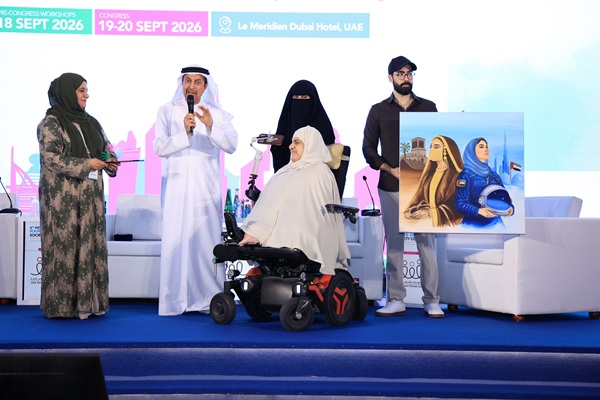
Held from
18 to 20 September at Le
Méridien Dubai under the
theme “United for Rare:
Empowering Families,
Advancing Care,” the
Congress brings together
physicians, researchers,
genetic specialists,
policymakers, patient
advocates and families from
the UAE and internationally
to discuss developments in
rare disease diagnosis,
treatment and support.
At the official opening,
H.E. Dr. Hussein Al Rand,
Assistant Undersecretary for
the Public Health Sector at
the Ministry of Health and
Prevention (MOHAP), said the
UAE is placing increasing
emphasis on building an
advanced healthcare system
centered on prevention,
early diagnosis, precision
medicine and modern genomic
technologies.
He said
these efforts are especially
important for people living
with rare and inherited
diseases, which often
require coordinated,
multidisciplinary care.
Dr. Al Rand said MOHAP
is supporting national
efforts to prevent and
identify inherited
conditions early by
strengthening genetic
screening and counselling
services. Priorities include
further developing the
premarital genetic screening
system, supporting newborn
screening programs, and
expanding diagnostic
capabilities in line with
advances in genomic and
personalized medicine.
Congress highlights
latest developments in rare
diseases
The Congress
scientific program covers a
broad range of developments,
including premarital and
newborn genetic screening,
advanced sequencing
technologies, laboratory
diagnostics, innovative
therapies, and gene therapy.
Sessions also address
metabolic diseases,
treatable rare disorders,
genetic ethics, and the
interpretation of genetic
test results, reflecting the
growing role of genomic
medicine in the diagnosis
and management of rare
conditions.
Dr. Al
Rand said scientific
advances are creating new
opportunities for patients
and families, but
translating these
developments into improved
outcomes requires stronger
links between research and
clinical practice.
He
highlighted the importance
of earlier diagnosis, clear
referral pathways,
healthcare professional
training, and closer
collaboration among health,
academic, research, and
social sectors.
He
also stressed that rare
disease care extends beyond
the patient to the entire
family. Psychological and
social support, family
empowerment, inclusion of
people of determination and
access to appropriate health
and social services are
therefore integral to
comprehensive care.
UAE to host
International MPS Network
Conference in 2028
A key announcement at
the Congress was the UAE’s
successful bid to host the
International MPS Network
(IMPSN) Conference in 2028.
Dr. Noha Al Zaabi, President
of the Congress, Consultant
in Genetic and Metabolic
Disorders and Board Member
of the UAE Rare Disease
Society, said the UAE will
become the first country in
the Middle East and North
Africa to host the event.
“The 4th International
UAE Rare Disease Society
Congress is more than a
scientific event; it is a
platform for hope,
partnership and action,” Dr.
Al Zaabi said. “By bringing
together healthcare
professionals, researchers,
policymakers, patients and
their families, we can
translate knowledge into
earlier diagnosis, better
treatments, stronger support
systems and a brighter
future.”
The Congress
features two principal
tracks — scientific and
family — with more than 70
speakers and session chairs,
including 15 international
speakers. The program
includes approximately 43
lectures, nine scientific
and family workshops, and
six specialized symposia.
Family needs
placed at the center of
Congress
Nafisa Tawfiq, Chairperson
of the UAE Rare Disease
Society and Chair of the
Organizing Committee, said
the Society works to connect
people living with rare
diseases and their families
with decision-makers,
healthcare providers,
supporting organizations,
and the wider community.
Held in
conjunction with the UAE’s
Year of the Family, the
family program addresses
quality of life, government
services, premarital genetic
screening, and family
support. It also includes
new support and advocacy
initiatives and discussions
on strengthening
international partnerships.
Sessions during the
Congress have addressed the
transition of adolescents
with inherited metabolic
diseases from pediatric to
adult care, long-term
follow-up, late-presenting
symptoms, and multisystem
complications.
A
dedicated session on
premarital genetic screening
examined its medical,
social, and legal
dimensions, including
informed decision-making,
genetic counselling,
individual rights, and
privacy.
The program
has also explored emerging
targeted treatments,
including molecular,
genetic, and enzyme-based
therapies, as well as
laboratory technologies
designed to accelerate and
improve the diagnosis of
rare diseases.
Focus on inclusion
and patient support
Patient and family
experiences are another
central component of the
Congress. Sessions have
highlighted community
initiatives supporting
children with rare diseases
and their families,
including the work of
Morocco’s Sawt Al Qamar
Association with children
living with xeroderma
pigmentosum.
The
Congress has also examined
services for people of
determination, including
assessment, social support,
protection mechanisms,
family services, and
pathways designed to promote
independence, inclusion, and
quality of life.
The
scientific program
additionally explores the
use of artificial
intelligence to help
patients and families
organize medical information
and formulate more precise
questions when communicating
with healthcare teams.
The Congress is held
under the patronage of MOHAP
and brings together
government entities,
healthcare providers,
academic institutions,
researchers, and patient
organizations to strengthen
collaboration in rare
disease care.
The 4th
International UAE Rare
Disease Society Congress
2026 is accredited by the
European Accreditation
Council for Continuing
Medical Education (EACCME)
for up to 15 European CME
credits.
 PRINT
THIS ARTICLE
PRINT
THIS ARTICLE
|